
I didn’t understand what the small girl in her mother’s arms was saying. I was staying with Ananda friends in Argentina, where little girls speak only Spanish, while I speak only English.
Miranda was 2-3 years old and very shy towards this stranger staying in her home with her parents. Miranda pointed to me, and with the quiet authority that children sometimes command, spoke to her mother.
Mom became very quiet and thoughtful, so I finally asked, “what did she say?”
“Miranda pointed to your shirt and said, “That’s the color of God.”
I was wearing the blue color that members of the Nayaswami Order wear. It was my turn to become thoughtful. Until then, I never considered that God had a particular color. More compelling was the quietly confident way Miranda implied that she saw God, and therefore knew God’s color!
Children often speak the highest truths, before their pure hearts become conditioned by the world to have more “adult” attitudes. Jesus Christ famously said, “Blessed are the pure in heart, for they shall see God.”
I’ll just touch on the idea of God’s color here. There is certainly some truth to blue being the color of God! Paramhansa Yogananda and Swami Kriyananda have said, in various ways, that “blue is the color of the Christ consciousness.” Lord Krishna is typically depicted as having blue skin. In one of his poems in Whispers from Eternity, Yogananda wrote, “O Divine Mother, in Thy lotus feet of blue light, the bee of my mind is engrossed.”
The Spiritual Eye
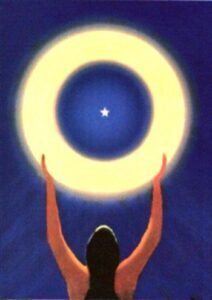
The spiritual eye, depicted in this painting by Kriyananda, is a reality that is universal to all souls. When you become very still in meditation, or after practicing certain techniques, you can see the spiritual eye behind your closed eyes. If you go deep enough, you can enter that tunnel of blue light, where everything becomes a brilliant “opal blue,” just as Yogananda described it.
Now, philosophers and intellectuals will argue about what is God’s real color, or that God is not a particular color. I’ll sit out such theoretical discussions and listen instead to a child that saw God.
Paramhansa Yogananda often urged his disciples to become more childlike (which is very different from being childish). He once surprised Swami Kriyananda with some children’s toys as a gift, then quoted the words of Christ to him, “Suffer little children to come unto me, for of such is the kingdom of God.”
At the time, Kriyananda was still struggling with intellectual doubt, which drives away the presence of God. Typical grownup attitudes—which too often include skepticism, doubt, intellectual pride and egotism—are absent in the great masters who see and know God.
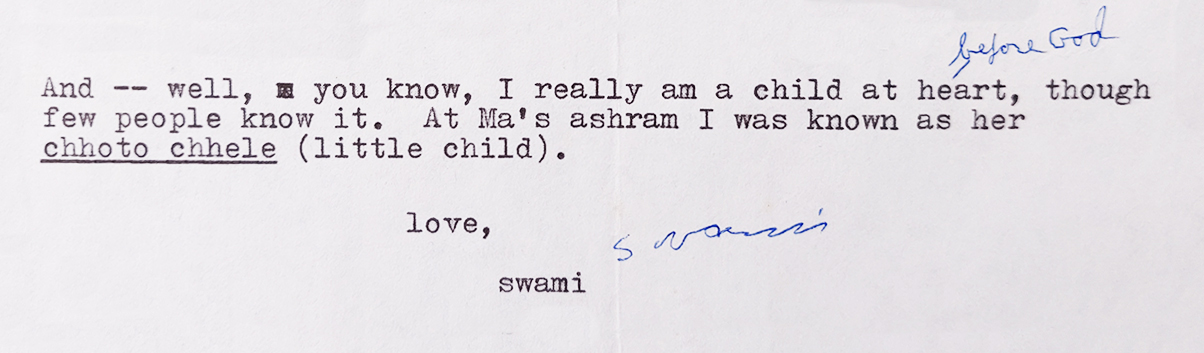
Kriyananda learned his Guru’s lesson well—at times you could see he was a divine child above all else. I have a note from him, written while he was working on a children’s book. He wrote, “And – well, you know, I really am a child at heart, before God, though few people know it. At Ma’s ashram (Anandamayi Ma) I was known as her chhoto chhele (little child).”
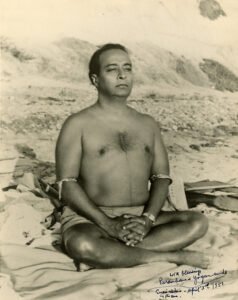
Swami Kriyananda once described Yogananda: “One of the most amazing things about Master was his complete inner freedom. In the deepest matters he maintained the simplicity and light-hearted innocence of a child.”
Pray Like a Child
If you want to see God, try to become more childlike and pure-hearted in your attitude. Pray as a child, not as a beggar or as an adult negotiating with God. Even when a child errs, it still approaches its Mother and ask forgiveness.
Yogananda taught us to pray as children:
“Never mind if you have erred. Just call to God with trusting love. Hide nothing from Him. He knows all your faults, far better than you do! Be completely open with Him.
“You may find it helpful to pray to God as your Divine Mother. For the Mother aspect of God is all-merciful. Pray, ‘Divine Mother, naughty or good, I am Thy child. Thou must release me!’
“Even the human mother loves her naughty children as much as her good ones. Sometimes she loves them even more, for their need is greater.
“Don’t be afraid of your Divine Mother. Sing to Her in this way from your heart: ‘Receive me on Thy lap, O Mother! Cast me not at death’s door.
Is Kriya Yoga a Breathing Exercise, a pranayam, or ?
Is Kriya Yoga a breathing exercise, a pranayam, or ? This is written more as an essay than a blog. The question of ‘what is
They Are Disciples of Paramhansa Yogananda!
“They Are Disciples of Paramhansa Yogananda!” In his autobiography, The New Path, Swami Kriyananda wrote: “In the sixty years, now, that I have been on
Blessed Are the Pure in Heart
Blessed Are the Pure in Heart This was first published in December, 2019. It’s especially relevant to those who practice yoga and meditation using techniques.