
Chapter Nine:
Control the Reactive Process
“The advanced yogi, withholding all his mind, will, and feeling from false identification with bodily desires, uniting his mind with superconscious forces in the spinal shrines, thus lives in this world as God hath planned, not impelled by impulses from the past nor by new witlessnesses of fresh human motivations. Such a yogi receives fulfillment of his Supreme Desire, safe in the final haven of inexhaustibly blissful Spirit.”
—Paramhansa Yogananda, Autobiography of a Yogi
I imagine that Yogananda’s lighthearted words, “new witlessnesses of fresh human motivations” will be humorously familiar to most of us. To win our daily struggle with wrong motivations, we must understand what he called the reactive process, described here by Swami Kriyananda:
The upward and downward currents in ida and pingala [two of the spinal channels] relate directly to the waves of our own reactive process — the likes and dislikes which form the basis of our delusion. By concentrating on these inner currents rather than on the specific outward objects of our likes and dislikes, we can gradually bring our entire reactive process under control, ultimately neutralizing it.
— Swami Kriyananda, The Art and Science of Raja Yoga
Our reactions to external events — influenced by our likes and dislikes — are the true cause of suffering. Many minds rebel at that idea. The outer dramas of life are so compelling! The mind so easily thinks that what happens to us is the real problem, and that all we need to do is fix or avoid outer events.
The enlightened yogi, instead, says to himself, “no, you only think it’s happening out there. The reality is that it’s all happening in here, in your reaction to events and desires.”
To help us understand the reactive process, let’s imagine some dramatic event. After purchasing many lottery tickets over the years, we find that we’ve won. Suddenly, we’re a millionaire!
Imagine your reaction — the excited intake of breath, corresponding to a rising energy in the spine as you absorb the news. You feel lighter, happier, energized. After a moment to collect yourself, you double-check the numbers, and — oops! — you realize that you were looking at last week’s numbers! Suddenly you’ve lost your million-dollar bonanza! You let out a long, slow sigh, as your energy falls.
Outwardly nothing has changed — the only difference is your reaction and the inner flow of energy. You can also see how closely your physical breath is related to your mood swings.
The intimate connection between breath, energy, and feeling explains why many yoga techniques, including Kriya, make use of the physical breath to help us gain control of our emotions and inner energy.
The yogis teach that the very cause of elation and sorrow is the energy in the spine, and that moods are not caused by anything outside of our own self. Kriya Yoga helps us to become aware that the real source of joy or suffering is within. Kriya gives us the means to control that inner energy, and to control the reactive process.
One who has fully gained that control is free from all suffering, untouched by outward events and their influence. In Yogananda’s words, that yogi remains ever “safe in the final haven of inexhaustibly blissful Spirit.”
You may ask, “what about us mortals who don’t have such superhuman control?” Here is the story of one such mortal who overcame a strong fear of death before the time of actual passing.
My wife was a Kriya Yogi for the last thirty-five years of her life. She could not let go of an irrational —for a yogi — fear of death. For ten of those years she fought a courageous battle with breast cancer. After the cancer was in remission, she began feeling symptoms of something not right in her brain. Her clear intuition told her that the cancer had returned and spread to the brain. Within days, extreme dizziness and vision problems took away her ability to stand by herself.
She was completely at peace — even beyond peace, hers was a state of joyful freedom. When I made an appointment for an MRI scan on her brain, she laughed, “If I don’t have brain tumors, I’ll eat my socks!”
As I wheeled her through the hospital corridor for the brain scan, she remained calm and quiet. Meanwhile I was falling prey to the extremes of my emotional reactive process. She sensed my turmoil. A true yogi, instead of comforting me emotionally, she quietly said , “Detach yourself. Control the reactive process. Live the teachings.”
The MRI indeed showed many tumors in her brain. The doctor wouldn’t say how many, only that she had no more than a few weeks to live. Maria spent those last few weeks in an elevated state of calm joy. Among her last words to me, spoken with inexpressible joy, were, “Don’t worry, I’m free.”
Her practice of Kriya, in cooperation with divine grace, had freed her of any negative reactive fear towards death. Lest you think hers is a rare story, I highly recommend the book, Transitioning in Grace by Ananda author Nalini Graeber. Nalini tells Maria’s story, along with those of many more Kriya Yogis who made similarly joyful final passages through the last stage of life.
Inner freedom amidst the seemingly endless emotional ups and downs of life is the final proof of the practical science of Kriya. It gives a freedom that can be attained by all who follow it sincerely, as Yogananda so clearly promised:
Practice Kriya night and day. It is the greatest key to salvation. Other people go by books and outer disciplines, but it will take them incarnations to reach God that way. Kriya is the greatest way of destroying temptation. Once you feel the inner joy it bestows, no evil will be able to touch you.
Control of the reactive process brings together all of the parts of the art and science of Kriya Yoga that we’ve discussed. This control is one of the great fruits of pranayama. It calms the agitated feelings that hide our true soul nature. It gives us the ability to offer ourselves completely to God, holding nothing back. It is a direct way of cooperating with grace. It frees us from dire fears and sufferings. It gives us freedom from karma and control of our own destiny.
That inner freedom is a great gamechanger on the spiritual path. Gradually, and then completely, one is unaffected by the ups and downs imposed by karma and a fickle world. Under all circumstances we can feel the same calm joy — the fruit not of a heart deadened to grief and suffering, but of sensitive attunement to the divine joy within.
Kriya Yoga transforms everyone into the highest versions of themselves, as divine human beings, as parents, teachers, artists, scientists, and friends. You will find yourself becoming a cause for change in your own life and in the lives of others — proactive rather than reactive.
Control of the reactive process gives us freedom from the wheel of karma and reincarnation. When we no longer react to events in life with “new witlessnesses” and wrong choices, we no longer create the manifold wrong karmas that keep us bound in suffering, life after life.
Kriya is based on certain universally known (because experienced) facts of human nature. Of course, it takes one far beyond common experience, but its fundamentals can be observed by anybody.
The Kriya science begins with the physical symptoms accompanying emotional reaction. In this reactive process, when one is delighted by, let us say, a sudden and unexpected gift, he tends instinctively to take a quick, sharp breath. When, on the contrary, one meets with a sudden setback, the automatic tendency of people is to blow the breath out. Exultation is accompanied by inhalation, followed perhaps, by a glad cry. Gloom or disappointment is accompanied by a heavy sigh.
“If you think about it, you will see that your actual reality lies not in outer things, but in your inner reaction to them. It is because watching a beautiful sunset makes you inwardly happy that you continue watching it. If that same sunset makes any impact at all on a turtle, it may be only to waken the idle question in its mind as to whether it is something good to eat. One finds difficulty in even imagining a turtle gazing at a sunset in rapt wonder. To the turtle, the sunset must hardly even exist. What makes that sunset real for human beings is the fact that they feel enough stimulated by it to react to it.”
— Swami Kriyananda, Paramhansa Yogananda: A Biography
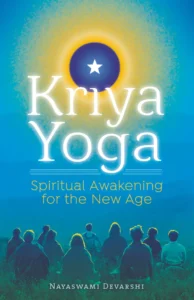
Excerpts
Chapter Titles
- Kriya Yoga: Spiritual Awakening for the New Age
- An Age of Energy
- Change Your Magnetism
- “Pranayam Be Thy Religion”
- Combining Art & Science
- Feeling: From Human to Divine
- The Fire of Devotion
- Cooperating with Grace
- Control the Reactive Process
- Karma, Kriya, and Action
- Change Your Destiny
- The Goal: Self-Realization
- Transcending the Ego
- The Need for a Guide
- The Technological Yogi
- Inner Communion
- The Final Exam
Recent Blogs
Is Kriya Yoga a Breathing Exercise, a pranayam, or ?
Is Kriya Yoga a breathing exercise, a pranayam, or ? This is written more as an essay than a blog. The question of ‘what is
They Are Disciples of Paramhansa Yogananda!
“They Are Disciples of Paramhansa Yogananda!” In his autobiography, The New Path, Swami Kriyananda wrote: “In the sixty years, now, that I have been on
Blessed Are the Pure in Heart
Blessed Are the Pure in Heart This was first published in December, 2019. It’s especially relevant to those who practice yoga and meditation using techniques.