Introduction
Nayaswami Devarshi
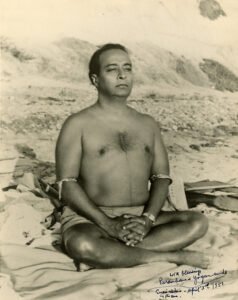
In August 1920, a young Paramhansa Yogananda, author of Autobiography of a Yogi, set out on the long ocean voyage from his native India to America, bringing with him the ancient teachings of meditation and Kriya Yoga.
When asked, “Is your teaching a new religion?” Yogananda replied, “It is a new expression of truths that are eternal.”
His simple words refer to Sanatan Dharma, the eternal truth which predates all religions.
Yogananda declared, “You are on the eve of a great spiritual awakening, a great change in the churches, where true souls will be drawn to seek the experience of God’s presence.”
Formal religion focuses mainly on outward rituals, dogmas, and rules, and on the false notion that the worshiper can only approach God through the intercession of a priest. Yogananda called such religion — equally common East and West — “Churchianity.”
Yogananda’s teacher, Swami Sri Yukteswar, explained that the planet has entered into a new age. He wrote that we have exited Kali Yuga, an age of materialism and outward form. Only recently has the planet moved into Dwapara Yuga, an age of energy, growing awareness, and fluidity. Modern science has shown that matter is energy.
Every significant invention of the twentieth century is based on the new energy-awareness, from telegraphs, telephones, and radios, to countless electronic technologies and gadgets that have fundamentally changed people’s lives.
A new understanding is similarly growing in spirituality and religion. Many people now question the purpose of outward forms and rituals — they seek instead the direct inner experience of higher truth.
Yogananda dedicated his life to showing how to have that direct personal experience. Essential to his mission was introducing the ancient teachings of Kriya Yoga and writing fresh interpretations of two of the great world scriptures, the Bhagavad Gita and the Bible.
Kriya Yoga (which I will often refer to as “Kriya”) is more than a technique. Yogananda gave the technique of Kriya to his students as part of a comprehensive way of life, designed to help them individually realize their soul natures — and to bring that realization into their daily lives.
Millions would learn about Kriya Yoga from Yogananda’s Autobiography of a Yogi, published in 1946. I was surprised to read that Kriya, or a similar technique, was taught by Krishna to his disciple Arjuna, by Christ and his disciples, by the Indian sage Patanjali, and by many other enlightened teachers over the centuries.
“The Science of Kriya Yoga,” a central chapter in his autobiography, bridges the divide between science and religion. The yoga science is based upon universal inner realities. Two simple examples: someone sitting upright with a straight spine will feel more energy than someone sitting slumped over; someone whose eyes are gazing upward will feel more uplifted than someone looking down. These responses come regardless of our religious beliefs.
Meditation is also an art. The highest expression of any art, such as painting or music, is much more than demonstration of technique. Great artists work with feeling and intuition. Perfect technique alone never makes an artist’s works great. Nor can spiritual techniques alone, including Kriya Yoga, make someone a saint, one who has realized God.
In Autobiography of a Yogi, Yogananda recalls his boyhood meeting with a great yogi-saint, Bhaduri Mahasaya, who said to him:
“You go often into the silence, but have you developed anubhava [actual perception of God]?” He was reminding me to love God more than meditation. “Do not mistake the technique for the Goal.”
The saints of all traditions are living canvases demonstrating the highest human art and science.
Paramhansa Yogananda predicted a bright future for humanity: a future with a unitive understanding of the shared reality that connects us all. That understanding will lead to fulfilling Yogananda’s broader mission, to “inspire the nations to forsake suicidal wars, race hatreds, religious sectarianism, and the boomerang-evils of materialism.”
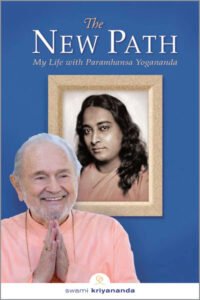
He commissioned a direct disciple, Swami Kriyananda, with showing how his teachings could shed light on every aspect of human existence. The monastic name, Kriyananda, is unusual in the Indian tradition — Kriya means “action” and “ananda” means “divine bliss.” Thus “Kriyananda” means “one who strives to realize the bliss of his nature through right action, including the practices of Kriya Yoga.”
Swami Kriyananda dedicated his life to showing how to apply the teachings of Sanatan Dharma and the practices of Kriya Yoga to every aspect of life. The Ananda communities he founded are living laboratories of this practical science and art. They are proof that a spiritual life can create bonds of harmony and cooperation between souls from all religious, cultural, and national backgrounds.
This book is the fruit of more than forty years of personal experience of the Kriya path and teachings, most of which have been devoted to sharing them with others.
Whether you are already a practitioner of Kriya Yoga or wish to learn more about Kriya, I hope this book will give you a better understanding of its depth and breadth. If you follow another spiritual practice, I believe the universal principles of Kriya can help shed light on your path.
— Nayaswami Devarshi
Humanity during Dwapara Yuga will cease to depend on crystallized political and institutional systems and will seek more fluid definitions of its ideals. In the past three centuries we have seen the wane of organized religion — of “Churchianity,” as Yogananda called it — and an increasing affirmation of the inner spirit of religion. Religion used to be identified with church affiliation and formal statements of belief; now it is becoming identified with inner Self-realization, and with a less structured, more informal fellowship of truth-seekers with one another.
— Swami Kriyananda
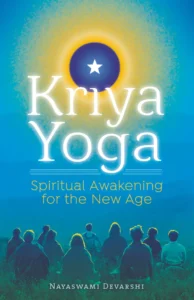
Chapter One: Kriya Yoga: Spiritual Awakening for the New Age